In recent decades, laser therapy has emerged as a groundbreaking non-invasive treatment modality, revolutionizing how we address pain, inflammation, and tissue repair. By harnessing the unique properties of laser light, this technology offers precise, efficient, and safe solutions for a wide range of medical conditions. Let’s delve into the science, mechanisms, and applications that make laser therapy a cornerstone of modern rehabilitation and medical care.
At its core, laser therapy relies on the interaction between concentrated light energy (photons) and biological tissues. Lasers, distinct from ordinary light sources, possess four key properties that enable their therapeutic efficacy: monochromaticity (single wavelength), collimation (parallel light beams), high brightness, and coherence (synchronized wavefronts). These properties allow laser light to penetrate tissues with minimal scattering, delivering energy precisely to target cells—typically mitochondria, the "powerhouses" of cells.
Lasers are categorized based on their wavelength, power, and application. Common types include solid-state lasers (e.g., Nd:YAG, 1064nm), gas lasers (e.g., CO₂, 10,600nm), and semiconductor lasers (e.g., 808nm, 650–850nm). Wavelength plays a critical role in determining penetration depth: longer wavelengths (e.g., 810nm, 1064nm) penetrate deeper into tissues, making them ideal for treating musculoskeletal issues, while shorter wavelengths (e.g., 532nm, 694nm) are effective for superficial conditions like skin lesions.
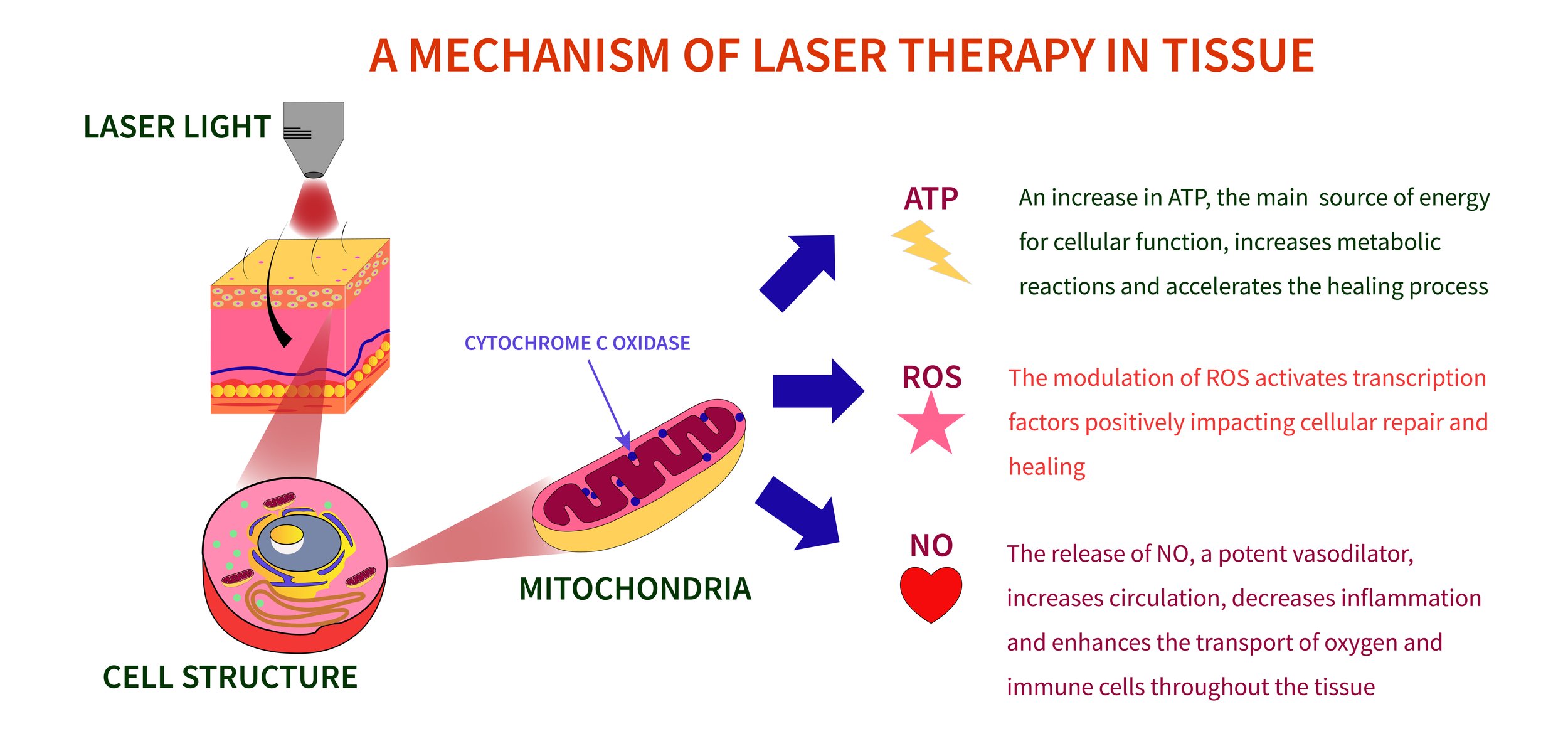
The therapeutic effects of laser therapy stem from its ability to trigger specific biological responses at the cellular level. When photons are absorbed by mitochondria, they interact with a key enzyme called cytochrome c oxidase, initiating a cascade of beneficial reactions:
-
Increased ATP Production: ATP, the primary energy currency of cells, is synthesized at an accelerated rate. This boosts cellular metabolism, speeding up tissue repair and regeneration.
-
Modulation of Reactive Oxygen Species (ROS): Low levels of ROS activate transcription factors involved in cellular repair, enhancing the healing process.
-
Release of Nitric Oxide (NO): A potent vasodilator, NO improves blood circulation, reduces inflammation, and facilitates the transport of oxygen and immune cells to damaged tissues.
Laser therapy devices are classified by their power output, which dictates their application and usage:
- Class III Lasers: These low-power devices (typically <500mW) are used for superficial treatments. They allow contact-free therapy, making them convenient for sensitive areas. Their beam strength is relatively low, limiting penetration to shallow tissues—ideal for minor wounds or skin conditions.
- Class IV Lasers: High-power systems (>500mW) require direct contact with the skin. They deliver deeper, more intense energy, making them effective for treating deep-seated issues like joint inflammation, muscle strains, or post-surgical recovery.
The 808nm wavelength, commonly used in both classes, strikes a balance between penetration depth and safety, making it versatile for various therapeutic needs. Effective dosage also depends on treatment time, with longer sessions often yielding better results for chronic conditions.
Laser therapy’s versatility has led to its adoption across numerous medical fields:
- Musculoskeletal Disorders: Arthritis, back pain, and sports injuries benefit from deep-penetrating wavelengths that reduce inflammation and promote tissue repair.
- Wound Healing: Diabetic ulcers, post-surgical wounds, and burns heal faster due to enhanced cellular activity and improved circulation.
- Dermatological Conditions: Acne, scars, and pigmentation issues are addressed using targeted wavelengths that stimulate collagen production and regulate melanin.
- Pain Management: By inhibiting pain signals and reducing swelling, laser therapy offers a drug-free alternative for chronic pain.
One of the most compelling aspects of laser therapy is its safety profile. Unlike thermal-based treatments, it does not cause burns or tissue damage, though patients may feel a mild, pleasant warmth. Clinical studies confirm minimal adverse effects, even with long-term use.
Its advantages include:
- Non-invasive and drug-free
- Fast treatment times (typically 5–15 minutes)
- No downtime
- Suitable for all ages and skin types